


YOUR CART
- No products in the cart.
Subtotal:
R0.00
BEST SELLING PRODUCTS


R1,700.00

Original price was: R1,100.00.R935.00Current price is: R935.00.
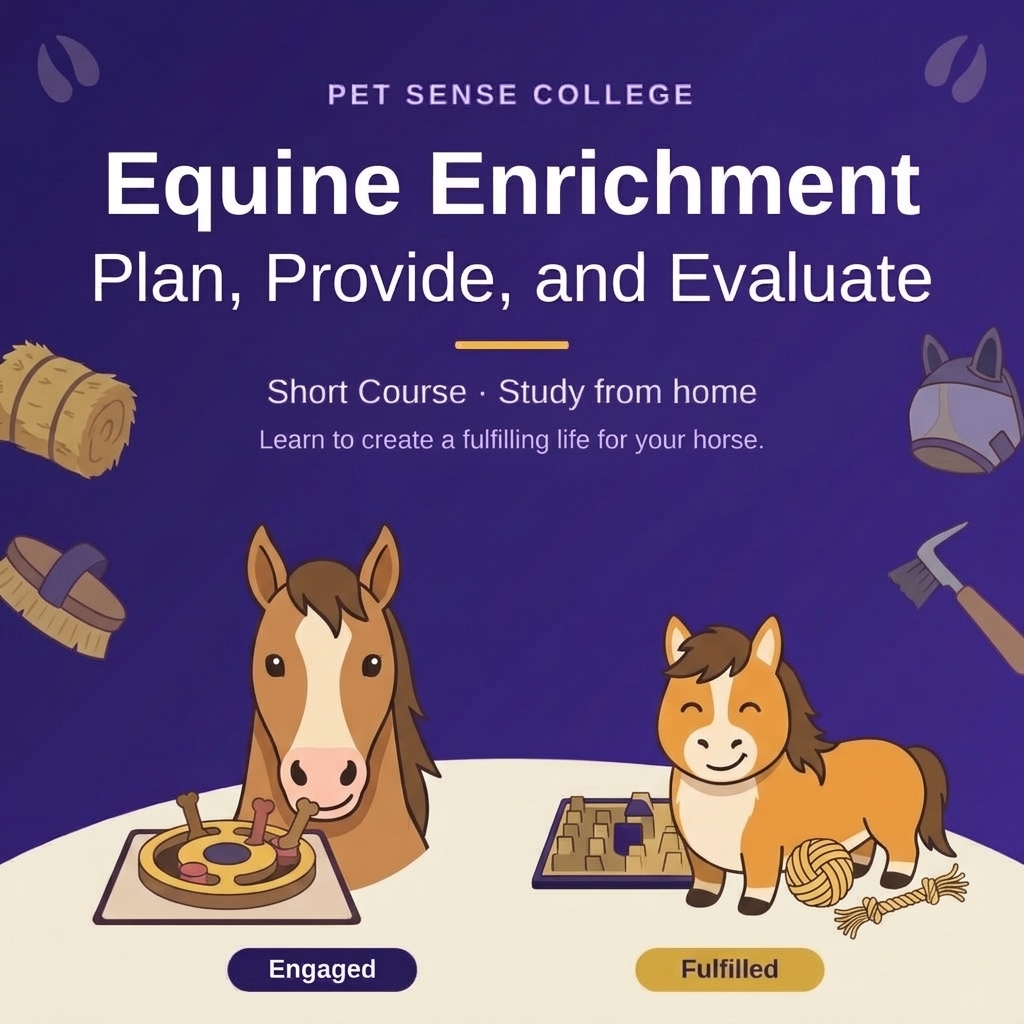
Learn to plan enrichment around the individual horse—not simply add more toys or activities. This focused short course explores how forage provision, social opportunities, movement, exploration, learning and choice can contribute to a more suitable daily environment.
Designed for equine professionals and aspiring practitioners, the course combines accessible explanations with practical examples relevant to South African yards. Develop a structured approach to assessing needs, checking risks, preparing realistic recommendations and evaluating the horse’s response.
Move beyond generic enrichment lists. Learn to explain why a change may suit a particular horse, what must be checked before introducing it and when the arrangement needs adapting or stopping.
The course begins with the foundations of appropriate care: friends, forage and freedom. It distinguishes essential needs from additional activities and examines why enrichment should not be used to compensate for unsuitable management.
Study from home using a detailed study guide, three learning activities, a core opportunity summary and reusable planning and review templates. No previous work experience or access to a horse is required.
The course is suitable for yard managers, grooms, equine behaviour practitioners, trainers, welfare workers and other professionals caring for horses or advising on their management.
It is particularly relevant to practitioners recommending enrichment for horses with behavioural challenges, and to caregivers and staff responsible for implementing agreed plans, recording observations and reporting concerns.
The course is delivered as one module containing six connected lessons:
On successful completion, you should be able to gather relevant background information, identify priorities and prepare a practical enrichment plan suited to the horse and its management.
You will also learn to assess equipment and environmental risks, respect veterinary and nutritional instructions, coordinate recommendations with other professionals and explain how provision should be monitored.
The emphasis is on informed decisions—not assuming that longer occupation, reduced movement or the disappearance of a visible behaviour automatically means improved welfare.
Explore the considerations behind suitable forage presentation, slow-feeding equipment, approved browsing, accessible food searches, social contact, safe exploration, preferred grooming, scratching surfaces and achievable learning activities.
For each opportunity, consider its intended purpose, suitability, precautions and review requirements. The course also examines the limits of toys, mirrors and novelty, and why changes to ordinary management may be more important than additional equipment.
Learn how enrichment can complement a wider care or behaviour-support plan. Worked examples address concerns involving feeding routines, social restriction, repetitive behaviour and difficulty accessing shared resources.
The course also considers planning under veterinary restrictions. Learners are taught to clarify what is permitted rather than independently change exercise, diet, turnout or social arrangements.
Duration: Approximately 10 hours in total, including study, activities and assessment. Individual study times will vary.
This is a one-module home-study course. The six lessons are sections within that module, not six separate modules.
Your learning materials include an expanded study guide, three learning activities, a core opportunity summary and reusable individual-background, enrichment-planning and observation-and-review templates.
Assessment consists of 17 short knowledge questions and one applied enrichment-planning task.
For the applied task, choose from three supplied cases: a predominantly stabled horse, a horse under veterinary movement restrictions or a horse experiencing difficulty accessing shared resources. Prepare a flexible two-week introductory plan, explain your recommendations and precautions, and include implementation instructions, monitoring criteria and a review arrangement.
No live-horse assessment or video submission is required. Both assessments must be completed successfully to receive a Pet Sense College certificate of completion.
This course develops introductory enrichment assessment, planning and review skills. It does not, on its own, qualify learners to diagnose disease, formulate therapeutic diets, prescribe rehabilitation exercise or independently treat complex behavioural problems.
It complements existing equine education and professional practice rather than replacing them. Learners are taught to recognise when recommendations require veterinary, nutritional, behavioural or other specialist input.
Develop a more individual, practical and welfare-led approach to equine enrichment through a manageable short course you can study from anywhere in South Africa.
Enrol online or contact Pet Sense College for registration information. Please review the published course-access, support and assessment terms before enrolling.
Questions? contact us via enquiries@petsensecollege.co.za


